
Who can run this project, out of this terminal, with what it demands?
And can I see all of it — service, capacity, availability, credentials and price — before I call?
12,308 carriers seen with an intermodal chassis by a federal inspector. And behind them, the whole register: each with what it declares about how it works.
Where the capacity is
The background is where carriers are domiciled; the yellow dots are the markets, with their terminals. Zoom in to separate the markets and click one to open the directory filtered by it.
- 1–38
- 39–179
- 180–464
- 465–1,055
- 1,056–12,721
Zero: our sources cover the region and record none.
No coverage: our Mexican and Canadian sources are terminal registries, so a region without a terminal does not show even if it has carriers.
One dot per market, not per terminal: the figure is the registry facilities it groups — berths, ramps, warehouses — not terminals. In the list, facilities · identified carriers.
Boundaries: U.S. Census Bureau; Statistics Canada, Open Government Licence – Canada; INEGI, Marco Geoestadístico 2024.
United Statesfacilities · carriers
- Los Angeles / Long Beach40 · 7,110
- Houston51 · 2,643
- Chicago25 · 2,511
- New York / New Jersey23 · 2,316
- Atlanta4 · 1,894
- Inland Empire1 · 1,842
- Oakland / San Francisco18 · 1,705
- Seattle / Tacoma36 · 1,679
- Dallas / Fort Worth4 · 1,582
Canadafacilities · carriers
Mexicofacilities · carriers
- Manzanillo2 · 59
- Progreso1 · 36
- Ensenada1 · 27
- Veracruz1 · 24
- Altamira / Tampico2 · 22
- Lázaro Cárdenas1 · 16
- La Paz2 · 7
- Coatzacoalcos1 · 7
- Salina Cruz1 · 6
Three ways in
Carrier
Be found by the right client, for what you can actually run and where you can actually get in.
Your listing already exists: it comes from the federal register. Claiming it turns it into a profile with more than forty attributes a client chooses by — which terminals you get into and ON WHAT ACCREDITATION: a Puerto Inteligente Seguro badge, Vancouver TLS approval, the Montreal Gateway register, CN or CP yard authorisation, C-TPAT, a bonded warehouse of your own — plus credentials, chassis, availability and hazard divisions. And into the place projects reach you with their structure already set. Your price is one of those attributes, not the headline.
Be found by the right client
3PL / Freight forwarder
Find the right partner for your project, without exposing your margin.
Buying and selling kept apart, per-project control of what your client sees, filters on the credentials and terminal access that actually stop a move, and private lists the carrier is never told about.
Find my partner
Shipper
Everyone answers your project in the same structure.
No all-in price that hides detention. Line haul, fuel, chassis and accessorials in the same shape from everyone, so comparing is comparing — and who you would be working with is visible before you decide.
Find my partner
We are not a TMS. We bridge the two sides.
The question you actually start with — who can run this project, out of this terminal, with what this move demands — is answered neither by the system that runs your operation nor by the place where loads get posted. It is answered where both parties enter the same project.
- We are not a TMS.
- A TMS runs ONE company's operation: its trucks, its drivers, its yard, its payroll. That is yours and stays yours. Our API is open in both directions precisely so that nobody has to change tools.
- We are not a load board.
- On DAT or LoadMatch the transaction happens OUTSIDE: the board puts you in touch and steps away. Nobody records what was agreed, on what credentials it ran, or who said what while the clock was running.
- We are the bridge.
- An integrating marketplace: both parties enter the SAME project and run it together. What was quoted, what was awarded, the milestones, the clocks and the documents live in one place both sides can see.
A board puts you in touch and steps away. A TMS runs your side and knows nothing of the other. Here the project is a joint concern for as long as it lasts: it is not theirs or mine, it is ours, and that is why it is run in a place both sides enter.
To be on PortPro you have to buy PortPro. To be on GatewayInAct you only have to want to be.
The difference is not price, it is the threshold. Rolling out a TMS is a months-long project. Putting your information in order here is an afternoon.
Open API in both directions, to any system that allows the integration. The bridge is crossed both ways, and neither company changes tools.
| What it is | What it does | Relation to us |
|---|---|---|
| A TMS — PortPro, Envase | Runs one company's internal operation: trucks, drivers, yard, billing. | Complementary. Whatever runs your side stays yours; the API connects it to the project. |
| A board — DAT, LoadMatch | Posts loads and puts people in touch. Whatever happens next happens elsewhere. | Complementary. That is where loose capacity is found; here a project is run. |
| GatewayInAct | The place where both parties enter the same project and run it until it is done. | This is what we are. |
All three are complementary, not competitors: one company can use all three on the same day.
What is actually in here
- 12,308Seen with an intermodal chassis
- A federal inspector recorded an intermodal chassis at an inspection. Register read on September 25, 2026. It is the only thing on this page nobody declares: somebody saw it. In the US, 3,002 of them declare the insurance the interchange agreement (UIIA) requires; 6,324 declare less than that minimum.
- 1,317From Mexican and Canadian registers
- Canada and Mexico: Montreal Gateway, the Vancouver TLS, the OBCCTC licence, the ASIPONAs and ANAM. Counts visible profiles only. Excludes those that only declare themselves on their own website.
- 55Declared on their own website
- Canada and Mexico: the company says so on its own website, and no register confirms it. It is their word, not a terminal's or a government's.
- 50,764From the United States federal census
- Companies near a terminal in the FMCSA census: they may serve even if they have not said so. It is not a drayage figure: that is the first one, and its companies are among these.
- 766facilities in the registry
- berths, ramps, customs warehouses and ports across 3 countries: each source’s own unit, not terminals
- 218markets
- the unit a buyer filters on
- 4code systems
- FIRMS, SPLC, CBSA, SAT — reconciled, not guessed
- 49accessorial charges
- one catalogue, so two quotes are comparable
- 3fuel indices
- EIA, NRCan, CRE — the surcharge follows a published series
Every number on this page is read from the database when the page is built.
How it goes, depending which side you are on
Carrier
- 1
Say which terminals you work
Search the registry of berths, ramps and ports by name, by market, or by whatever the gate calls them. Aliases resolve to the same place.
- 2
Fill in the profile a buyer filters on
Hazard classes by division, chassis by type, where you deliver, what you are approved for. A freshness score that says exactly what moves it.
- 3
Declare your price, alongside everything else
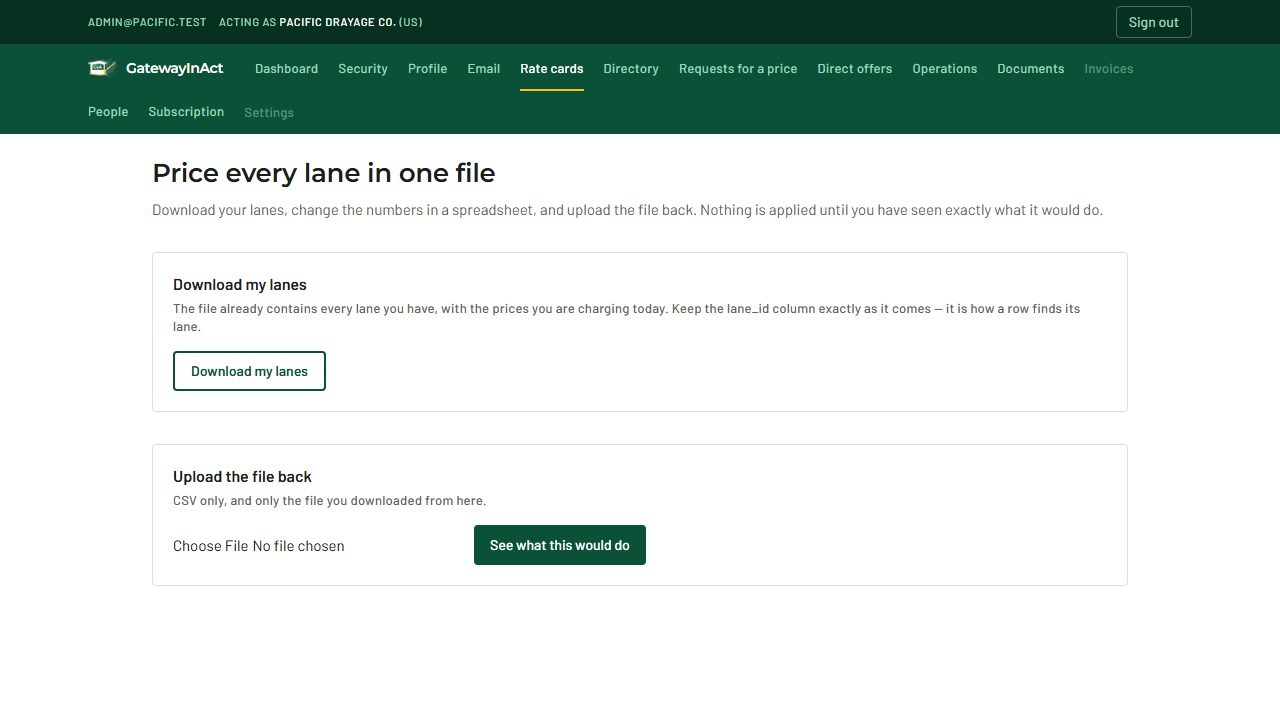
One lane in a form, or your whole network as a spreadsheet. Price is one of the things that make you eligible, and not the first thing someone looks at when they need to know who can run their project. Nothing is applied until you have seen what it would do.
3PL and 4PL
- 1
Filter by what your project demands, not by who comes to mind
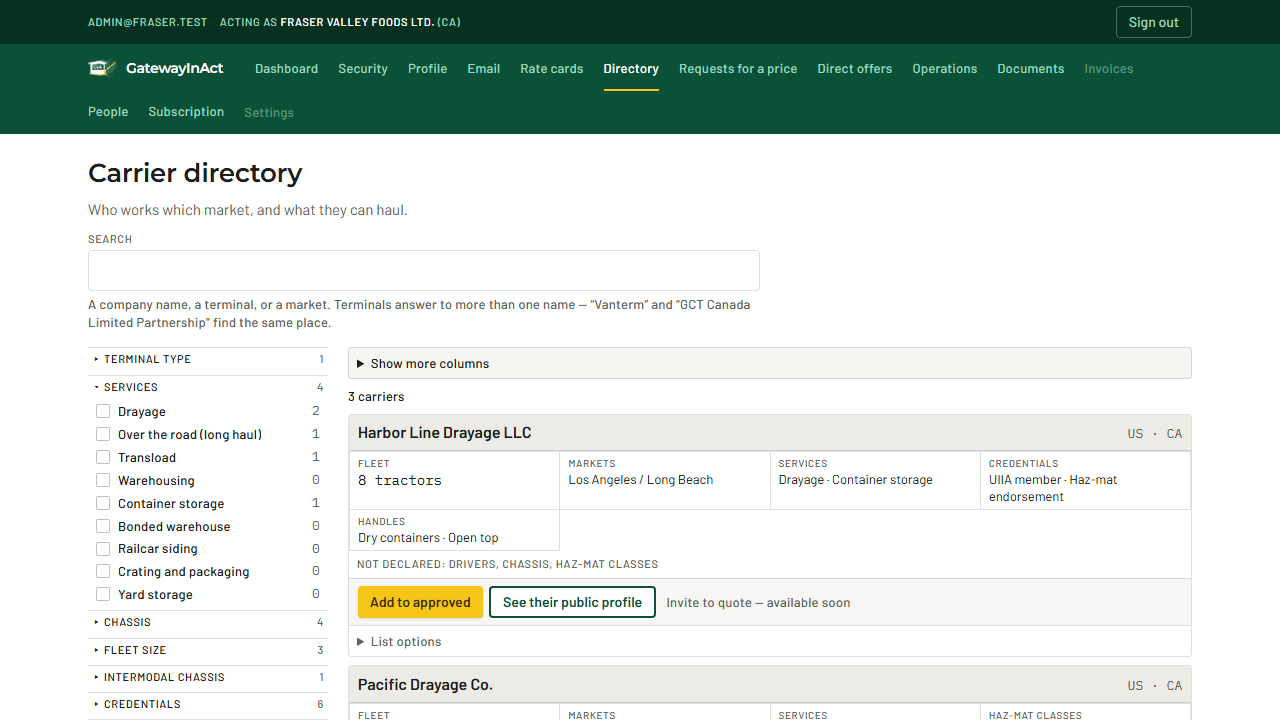
Terminal, gate access, credentials, chassis type, hazmat division, where they deliver. Across the whole federal register —50,764 companies near a terminal— not the list of whoever you called last time.
- 2
Compare the answers in one structure
Line haul, fuel against a published index, and accessorials everybody names the same way. No all-in number hiding detention, which is where the margin you thought you had goes.
- 3
Invite them to your project and keep what comes back
One carrier or several, with the project structure already set. Answers arrive comparable, and the partner you choose drops into your own system through the API — your margin never leaves here.
Shipper
- 1
See who serves your terminal, with nobody in between
The same directory and the same terminals a 3PL sees. Who has TWIC, who moves hazmat, who has their own chassis and who delivers in your area.
- 2
Ask for the price with the structure already set
Everybody quotes the same shape: line haul, fuel, accessorials. Comparing stops being three emails in three formats that you translate into a table by hand.
- 3
Know what you are buying before you sign
Every rate carries its version and its date, so a quote made a month ago resolves to the numbers it was made from. A dispute becomes answerable instead of an argument.
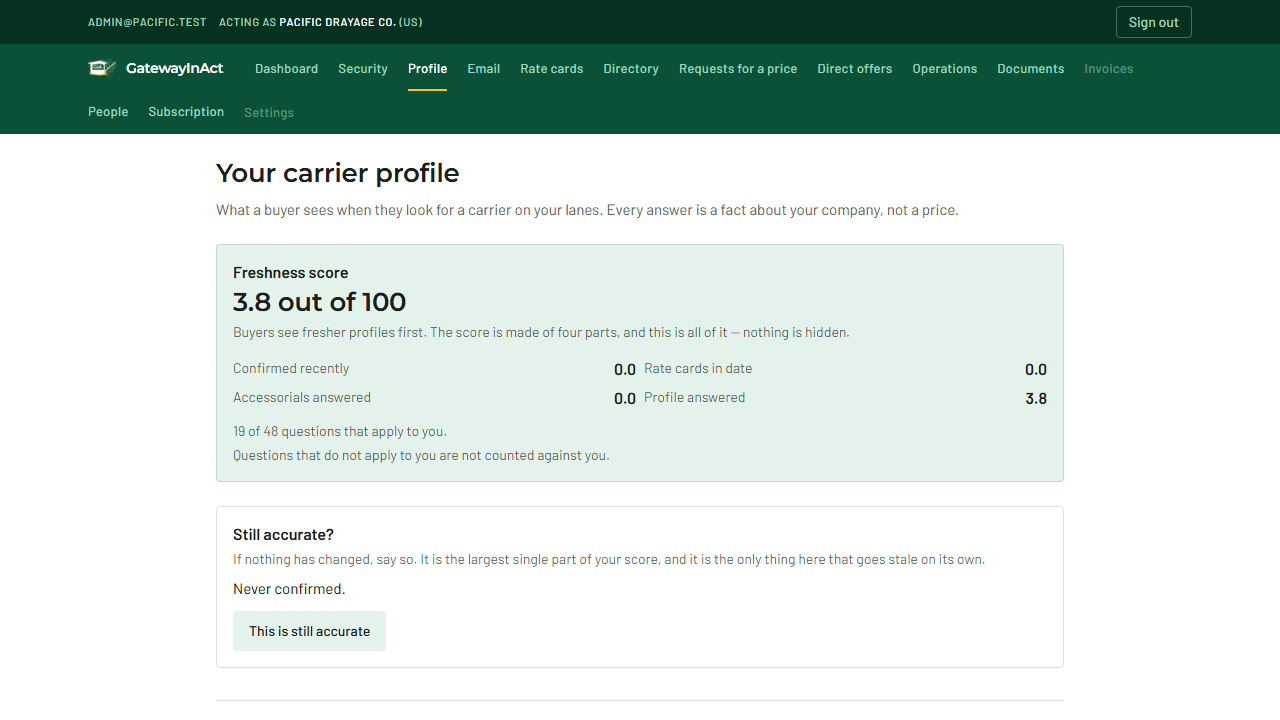
All three captures come out of the product when this page is built, not out of a design. If a screen changes and a capture goes stale, a test turns red.
Reference, free and without an email address
Per diem against demurrage. What a chassis split costs you. Carta Porte, CBSA sublocation codes, FIRMS. The things this trade assumes you already know.
Your company is already in the federal register. What is missing is what you can run.
Claiming a listing is an email and a form. From that moment your company shows what it actually does — which terminals it gets into, with which credentials, with what capacity and availability, and its price too — rather than only what FMCSA says exists. On the other side nobody has to register to look: the directory is open.
Be the first in your market. The profile comes first: your terminals, your access, your credentials, your chassis.